Kotak Infinity Equity Long-Short Fund: ISID, Exit Load & Tax
Kotak’s first equity long-short SIF can take limited short positions through derivatives and offers business-day dealing after the NFO. This guide covers the allocation, derivatives, fund managers, costs and tax.
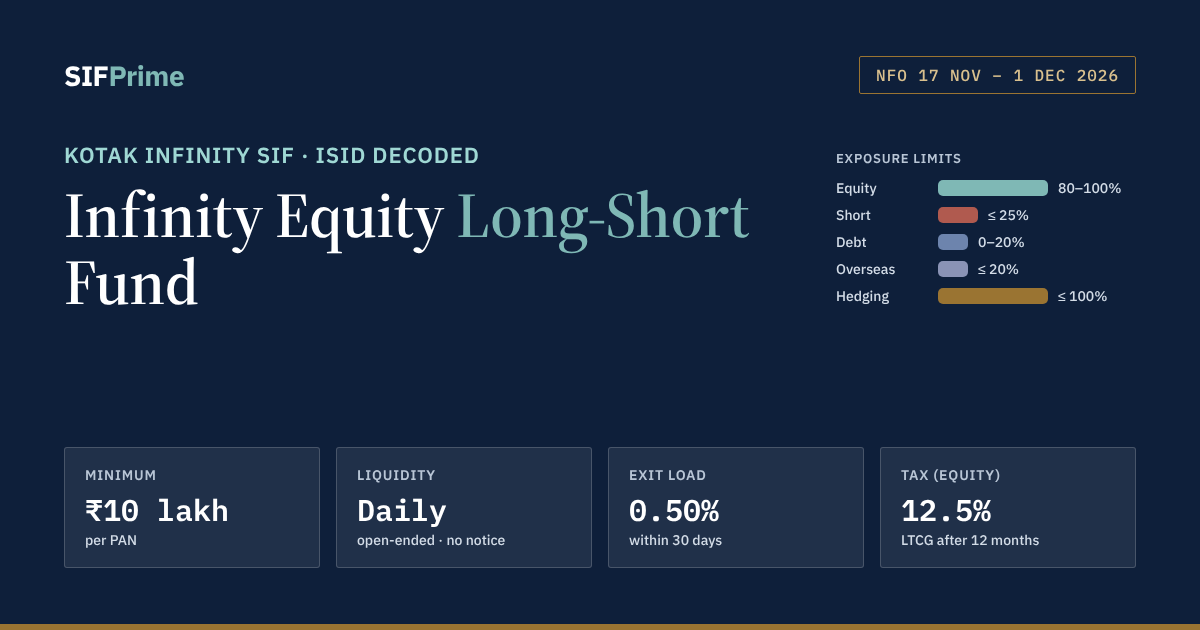
Read the official Kotak Infinity ISID (PDF) · View the Infinity fund profile
Most coverage of the Kotak Infinity Equity Long-Short Fund stops at the NFO dates, the ₹10 lakh minimum and the benchmark. The figures that decide whether it suits you are in the ISID (Investment Strategy Information Document, dated 27 October 2026). That's where you find how much can be shorted, how much can be hedged, which derivatives are allowed, what Kotak can charge and how it's taxed. This guide walks through each of them.
Kotak Infinity Equity Long-Short Fund: key details at a glance
| Parameter | Detail (as per ISID) |
|---|---|
| Strategy name | Infinity Equity Long-Short Fund |
| SIF brand / AMC | Infinity SIF, by Kotak Mahindra Mutual Fund |
| Category | Equity Long-Short Fund |
| Type | Open-ended equity strategy investing in listed equity, with limited short exposure through derivatives |
| Strategy code | INFI/O/E/ELSF/26/06/0002/KOTM |
| NFO period | 17 November 2026 – 1 December 2026 |
| Reopens for sale and repurchase | 10 December 2026 |
| NFO price | ₹10 per unit |
| Benchmark | NIFTY 100 TRI |
| Asset allocation | Equity 80–100% (including unhedged shorts) · Debt & money market 0–20% · InvITs 0–20% |
| Unhedged short cap | Up to 25% of net assets |
| Fund managers | Kalpesh Jain & Rohit Tandon (equity and overseas), Abhishek Bisen (debt) |
| Subscriptions / redemptions | Every business day; no notice period; payout within 3 working days |
| Exit load | 0.50% if redeemed/switched out on or before 30 days; nil thereafter |
| Minimum investment | ₹10 lakh (PAN level, across Infinity SIF strategies). The accredited investor minimum is ₹1 lakh. |
| Additional purchase | ₹10,000 and multiples of ₹1 |
| Plans / options | Regular & Direct · Growth (default) & IDCW (Payout / Reinvestment) |
| Base TER ceiling | Up to 2.10% on the first ₹500 crore of daily net assets |
| Risk band | Level 3 of 5 (at NFO stage); benchmark also Level 3 |
| Taxation | Equity-oriented: STCG 20% (≤ 12 months), LTCG 12.5% above ₹1.25 lakh (> 12 months) |
| Exchange listing | Not required (open-ended) |
What is Infinity SIF, and why does this launch matter?
A Specialised Investment Fund (SIF) is a SEBI category that sits between mutual funds and PMS/AIFs. A SIF keeps mutual fund structure, transparency and taxation, but its strategies can take unhedged short positions of up to 25% through derivatives. The entry ticket is ₹10 lakh.
Infinity SIF is Kotak Mahindra Mutual Fund's SIF platform. Its first strategy was the Infinity Hybrid Long-Short Fund (June 2026). The Equity Long-Short Fund is its second strategy and its first equity-oriented one. The ISID confirms Infinity SIF has no other strategy in the equity-oriented category yet.
That matters because equity long-short is where SIFs differ most from a regular equity fund. A hybrid long-short fund is mostly arbitrage and debt. An equity long-short fund is a real equity portfolio with a short book and an options overlay on top.
Asset allocation: what the ISID allows
Unlike a hybrid SIF, this is an equity-first mandate. At least 80% of total assets must be in equity and equity-related instruments, and that 80% includes the unhedged short book.
How the portfolio is built
The ISID describes four building blocks.
1. Long book (80–100%)
Bottom-up stock picking using Kotak's Business, Management and Valuation (BMV) model, looking for growth at a reasonable price (GARP). Valuation is based on DCF and P/E, with diversification across sectors and geographies.
2. Short book (up to 25%)
Unhedged short positions through stock futures, index futures and options. The aim is to profit from overvalued stocks or hedge broad market falls, so the fund can hold up better in bearish or volatile markets.
3. Liquidity sleeve (up to 20%)
T-bills, short-duration G-Secs and money market instruments. These provide income, a reserve to meet daily redemptions, cash for new opportunities and margin for derivative positions.
4. Hedging overlay (up to 100%)
On top of the 25% unhedged short, the remaining long equity and debt can be hedged up to 100% through futures, options, swaps and covered calls. The fund can go fully hedged when the managers turn defensive.
The ISID also allows up to 20% in overseas securities, for diversification across markets and currencies, with an allowance of up to US$100 million in the first six months after the NFO. It also permits InvITs, mutual fund units, securities lending and corporate bond repo.
Short, long and hedging limits
These are the guardrails that separate this fund from a regular large-cap fund.
Offsetting rules: what counts as a hedge
The ISID gives SEBI's illustrative offsetting rules for positions on the same stock and expiry. A few examples:
| Position 1 | Position 2 | Offset? | Net exposure counted |
|---|---|---|---|
| Equity long | Futures short | Yes | Equity long only |
| Equity / futures long | Call option short (covered call) | Yes | Equity / futures long only |
| Equity / futures long | Put option long (protective put) | Yes | Equity / futures long only |
| Futures short | Call option long | Yes | Futures short only |
| Equity long | Futures long | No | Both counted |
| Futures short | Put option long | No | Both counted |
The 25-strategy derivatives toolkit
The ISID lists 25 indicative derivative strategies. We've grouped them by what each one is for.
What a 25% short book actually does
SIF ISIDs must include AMFI's standard scenario analysis. Kotak's version runs a ₹10 crore portfolio through one market move: Nifty 50 +10%, IT sector −15%, Banking sector +8.5%. The examples vary the long allocation and the mix of short positions.
The lesson: shorting the right sector (IT) beat the fully long portfolio even in a rising market. Shorting the wrong one (banks) cut the return roughly in half. The short book doesn't just reduce risk; it's a second source of active bets. Stock and sector selection on the short side matters as much as on the long side.
Debt, credit and other limits
The debt sleeve is small, and the ISID keeps its credit risk on a tight leash.
| Instrument | Limit |
|---|---|
| Securitised debt | Up to 10% of the debt portfolio |
| Structured obligations / credit enhancements | Up to 10% of the debt portfolio |
| AT1 / Tier 2 bonds | Up to 10% of the debt portfolio |
| Overseas securities | Up to 20% of net assets |
| InvITs | Up to 20% of net assets; max 10% of NAV per issuer |
| Securities lending | Up to 20% of net assets; max 5% per intermediary |
| Repo in corporate debt | Up to 10% of net assets |
| Credit default swaps | Max 10% of net assets per counterparty |
| Mutual fund units | Up to 50% (aggregate inter-scheme cap of 5% of Kotak MF's NAV) |
| Bills rediscounting | Up to 5% of net assets (with recourse) |
| Exchange-traded commodity derivatives | Not permitted |
Rebalancing and deployment rules
- NFO money: to be deployed within 30 business days of allotment. The Investment Committee can extend this by another 30 business days.
- Passive breaches: to be rebalanced within 30 business days, extendable to 60. If it still isn't fixed, Kotak can't launch new SIF strategies, and investors can exit without an exit load.
- Defensive deviations: allowed for short periods, but must be rebalanced within 30 calendar days.
Who manages Kotak Infinity Equity Long-Short Fund?
The ISID names a three-person team. Kalpesh Jain and Rohit Tandon run equity and overseas investments; Abhishek Bisen runs debt and money market investments.
Kalpesh Jain
eMBA (MET Institute, Bandra). Over 18 years' experience. Previously a fund manager (AIF) at Tata Asset Management for 18+ months; earlier with Julius Baer, Ambit and Edelweiss Capital. Also manages Infinity Hybrid Long-Short Fund.
Rohit Tandon
B.E. Mechanical (Punjab University), PGDM (IIM Bangalore). Over 19 years in equity research and fund management. Previously Head of Equities at Reliance Nippon Life Insurance; 14 years as Senior Fund Manager (Equities) at Max Life Insurance; 4 years as a sell-side analyst at JP Morgan India.
Abhishek Bisen
BA Management, MBA Finance, EPAF (IIM Calcutta). At Kotak AMC since October 2006, managing debt schemes. Earlier at Securities Trading Corporation of India (fixed income sales and trading) and in merchant banking. Also manages Infinity Hybrid Long-Short Fund.
Why it matters: the equity side pairs a long-only large-cap manager (Tandon's insurance-fund background) with an AIF and long-short manager (Jain). The long book and the short book will likely reflect both styles.
Liquidity: daily, with no notice period
This is the biggest practical difference from the hybrid SIFs launched this year. Infinity Equity Long-Short is open-ended.
- Partial redemptions: Kotak can limit a partial redemption so that your remaining holding across Infinity SIF doesn't fall below ₹10 lakh.
- Minimum redemption: ₹10,000, or your whole holding if that is lower.
- NAV: first NAV within 5 business days of allotment; then published every business day by 11 pm (by 10 am the next day if the fund holds overseas assets).
- Portfolio disclosure: full portfolio published as of the last day of every alternate month, within 10 days.
- IDCW payouts: credited within 7 working days of the record date.
Exit load: 0.50% for 30 days
A 30-day load is short for an equity strategy, which fits the daily-liquidity design. Any exit load collected, net of GST, goes back into the fund.
Minimum investment, SIP, SWP and STP
| Facility | Minimum |
|---|---|
| Lump sum (new SIF investor) | ₹10 lakh, aggregated across all Infinity SIF strategies at PAN level |
| Additional purchase | ₹10,000 and multiples of ₹1 |
| SIP / SWP / STP | ₹10,000 × at least 6 instalments (after the ₹10 lakh threshold is met) |
| SIP top-up | Available |
| Minimum redemption | ₹10,000 or all units, whichever is lower |
If you already hold the Infinity Hybrid Long-Short Fund and your Infinity SIF holdings total more than ₹10 lakh, that counts towards the threshold. Holdings in Kotak's regular mutual funds do not count.
Expense ratio (TER): what Kotak is allowed to charge
There is no actual TER yet; Kotak will publish it from the first NAV date. The ISID sets the ceiling: a base expense ratio of up to 2.10% of daily net assets on the first ₹500 crore, falling as the fund grows.
For comparison, HDFC's hybrid H-SIF has a ceiling of 1.85% at the same slab. Equity strategies are allowed higher ceilings. The ISID's own illustration shows the cost of distribution: on ₹10,000 earning ₹800 a year, the Regular Plan keeps ₹700 and the Direct Plan ₹725.
Infinity risk band: what Level 3 means
Level 3 sits in the middle of the scale: higher than hybrid long-short SIFs (typically Level 1–2) and lower than several equity long-short peers rated Level 4–5. It still means real equity risk. The ISID also flags concentration risk: the portfolio may be spread across only a few selected sectors.
Taxation: equity-oriented
The rates below apply when the strategy qualifies as an equity-oriented fund for tax purposes. The domestic-equity tax test differs from the ISID’s broader 80–100% equity and equity-related allocation.
IDCW payouts are taxed at your slab rate, with 10% TDS above ₹10,000 for residents. Capital gains for unit holders generally arise on redemption, sale or a switch. Check with your tax advisor for your own case.
Kotak Infinity vs HDFC H-SIF: two very different SIFs
Kotak's and HDFC's November NFOs overlap, but they are built for different jobs. We decoded HDFC's ISID in HDFC H-SIF Hybrid Long-Short Fund: ISID, Exit Load & Tax.
| Feature | Infinity Equity Long-Short (Kotak) | H-SIF Hybrid Long-Short (HDFC) |
|---|---|---|
| Category | Equity long-short | Hybrid long-short |
| Equity allocation | 80–100% | 25–75% (largely hedged arbitrage) |
| Debt allocation | 0–20% | 25–75% |
| Unhedged short cap | 25% | 25% |
| Benchmark | NIFTY 100 TRI | NIFTY 50 Hybrid Composite Debt 50:50 |
| Liquidity | Daily, no notice period | Redeem Mon & Wed; notice up to 15 days |
| Exit load | 0.50% ≤ 30 days | 0.50% ≤ 90 days |
| Base TER ceiling (first slab) | 2.10% | 1.85% |
| Risk band | Level 3 | Level 2 |
| Tax | Equity: 20% STCG / 12.5% LTCG after 12 months | Listed non-equity: slab STCG / 12.5% LTCG after 12 months |
| Role in a portfolio | Core equity with downside management | FD/debt alternative with some upside |
Other equity long-short SIFs
Kotak is a later entrant in this category. Equity long-short SIFs already running or launched include:
| SIF brand | AMC |
|---|---|
| qSIF Equity Long-Short | quant Mutual Fund |
| Altiva Equity Long-Short | Edelweiss Mutual Fund |
| iSIF Equity Long-Short | ICICI Prudential Mutual Fund |
| DynaSIF Equity Long-Short | 360 ONE Mutual Fund |
| Sapphire Equity Long-Short | Franklin Templeton |
| Arthaya Equity Long-Short | Union Mutual Fund |
| MSIF Equity Long-Short | Mahindra Manulife Mutual Fund |
Exit loads, risk bands and actual short usage vary widely across these funds; some charge exit loads for up to a year. Compare live AUM, TER, net exposure and returns on SIFPrime Compare.
Who should consider Kotak Infinity Equity Long-Short Fund?
May suit
- Investors with ₹10 lakh+ who want large-cap equity exposure with an active hedge, not a fixed-income substitute
- Investors who need daily liquidity and don't want interval-fund redemption windows
- HNIs already in Kotak's Infinity Hybrid who want to add an equity sleeve on the same ₹10 lakh threshold
- Family offices looking for a lower-cost, transparent alternative to Category III long-short AIFs
Probably not for
- Anyone wanting FD-like stability; this is Level 3 equity risk
- Investors with a short horizon; it's an equity fund, and STCG within 12 months is 20%
- Those wanting a track record first; the fund is new
- Investors who already hold several large-cap funds and won't check for overlap
How to invest in Kotak Infinity Equity Long-Short Fund
- Check eligibility. You need ₹10 lakh at PAN level across Infinity SIF. Accredited investors can apply with ₹1 lakh. Regular Kotak MF holdings don't count.
- Complete KYC. A valid MF KYC is required (PAN, address, FATCA).
- Read the ISID and KIM. Focus on Section II (risk factors) and the derivatives and scenario sections.
- Choose a plan. Direct (lower TER) or Regular (through a SIF-registered distributor); Growth or IDCW.
- Apply during the offer window through Kotak Mutual Fund, CAMS, the exchange MF platforms or a registered distributor. Or invest after the fund reopens on 10 December.
- Compare before you commit. Use SIFPrime to compare Infinity against qSIF, Altiva, iSIF, DynaSIF and others on TER, exit load and actual short exposure.
Compare every equity long-short SIF side by side
TER, AUM, net exposure, exit loads and rolling returns, updated as each fund discloses its portfolio.
Open SIFPrime CompareWhat to watch after the NFO
- NFO size relative to Kotak's Infinity Hybrid Long-Short Fund.
- Net equity exposure. Look at gross long minus shorts and hedges, not just the 80%+ gross figure.
- Actual short usage. Most SIFs have stayed well below the 25% cap. Check whether Kotak's short book is sector bets, single stocks or index hedges.
- Use of the 50% unhedged long allowance. Track how futures and options affect the fund’s directional exposure.
- Options income. How much return comes from covered calls and premium selling, and how that holds up in sharp moves.
- Announced TER compared with the 2.10% ceiling.
- Overlap with Kotak's large-cap and flexi-cap funds, given the NIFTY 100 benchmark.
- Whether the risk band moves from Level 3 once the portfolio is built.
Frequently asked questions about Kotak Infinity Equity Long-Short Fund
What is the exit load of Kotak Infinity Equity Long-Short Fund?
0.5% of NAV if redeemed or switched out on or before 30 days from allotment; nil after that. No load on IDCW reinvestment units or switches between plans/options.
Can I redeem from Infinity Equity Long-Short Fund on any day?
Yes. It is open-ended, with subscriptions and redemptions on every business day and no notice period. Proceeds are paid within 3 working days.
Who are the fund managers?
Kalpesh Jain and Rohit Tandon (equity and overseas), and Abhishek Bisen (debt and money market).
What is the asset allocation?
Equity and equity-related instruments 80–100% (including up to 25% unhedged shorts), debt and money market 0–20%, and InvITs 0–20% of total assets.
What is the minimum investment?
₹10 lakh at PAN level across Infinity SIF strategies, or ₹1 lakh for accredited investors. The minimum is ₹10,000 for additional purchases and SIP instalments.
What is the benchmark?
NIFTY 100 Total Return Index.
When does the NFO open and close?
17 November to 1 December 2026, at ₹10 per unit. The fund reopens for continuous sale and repurchase on 10 December 2026.
What is the risk band?
Level 3 of 5 at NFO stage; the NIFTY 100 TRI benchmark is also Level 3. It may change once the portfolio is built.
What is the expense ratio?
The ISID allows a base TER of up to 2.10% on the first ₹500 crore of daily net assets, falling with size. Actual TER will be published from the first NAV date.
How is Infinity Equity Long-Short Fund taxed?
As an equity-oriented fund: 20% STCG if held 12 months or less; 12.5% LTCG above ₹1.25 lakh if held longer, plus surcharge and cess. Consult your tax advisor.
Is this Kotak's first SIF?
No. It is Infinity SIF's second strategy after the Infinity Hybrid Long-Short Fund, and its first equity long-short strategy.
Does the fund have past performance?
No. It's a new strategy with no track record.
Sources
- Kotak Mutual Fund’s official strategy page
- NSE circular confirming the NFO window
- Income Tax Department’s notified tax rules
- Kotak Mahindra Mutual Fund – Infinity Equity Long-Short Fund, Investment Strategy Information Document, dated 27 October 2026 (ISID PDF)
- AMFI – SIF industry AUM data, October 2026 (amfiindia.com)
Disclaimer: This article is for information and education only and is not investment, tax or legal advice, or a recommendation to buy or sell any security or strategy. SIF investments are subject to market risks, including the possible loss of capital. Read all strategy-related documents (ISID, KIM, SAI) carefully before investing. Figures are taken from the ISID and public sources as of 23 November 2026 and may change. Tax treatment depends on individual circumstances and prevailing law; consult a qualified advisor.