HDFC H-SIF Hybrid Long-Short Fund: ISID, Exit Load & Tax
HDFC Mutual Fund has launched its first Specialized Investment Fund strategy under the H-SIF brand. This guide covers the allocation ranges, derivatives limits, redemption days, exit load, fund managers, costs, tax and how the fund compares with its peers.
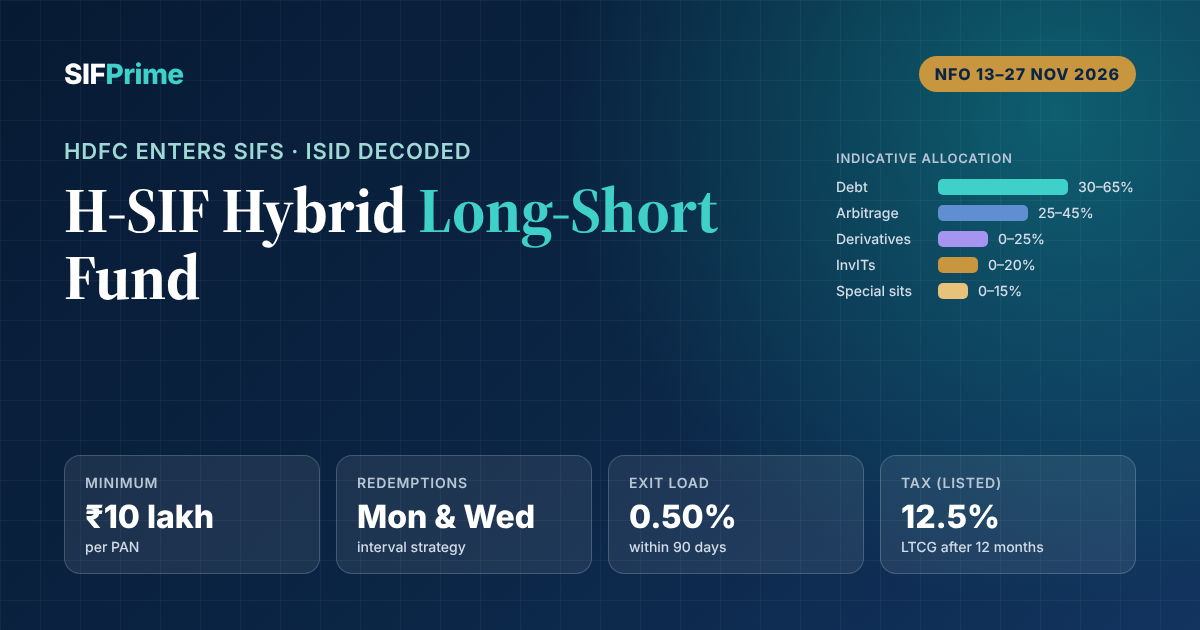
HDFC Mutual Fund’s H-SIF Hybrid Long-Short Fund is an interval strategy. The exit load is 0.50% on redemptions or switches out on or before day 90 from allotment and nil thereafter. HDFC’s FAQ gives a 12.5% long-term capital gains tax rate for listed units held more than 12 months, before surcharge and cess.
Read the official HDFC H-SIF ISID (PDF) · View the H-SIF fund profile
Most coverage of the H-SIF Hybrid Long-Short Fund stops at the press release: NFO dates, ₹10 lakh minimum, "Arbitrage+". The figures that decide whether this fund suits you are in the ISID, the SIF version of a mutual fund's SID. Those figures are the allocation bands, the limits on credit and overseas exposure, which days you can exit, and what the AMC is allowed to charge. This guide walks through each of them.
1. HDFC H-SIF Hybrid Long-Short Fund: key details at a glance
| Parameter | Detail (as per ISID) |
|---|---|
| Strategy name | H-SIF Hybrid Long-Short Fund |
| SIF brand / AMC | H-SIF, by HDFC Mutual Fund (HDFC AMC) |
| Category | Hybrid Long-Short Fund |
| Type | Interval investment strategy investing in equity and debt, with limited short exposure through derivatives |
| NFO period | 13 November 2026 – 27 November 2026 |
| NFO price | ₹10 per unit |
| Benchmark | NIFTY 50 Hybrid Composite Debt 50:50 Index |
| Asset allocation | Equity 25–75% · Debt & money market 25–75% · InvITs 0–20% |
| Unhedged short cap | Up to 25% of net assets |
| Fund managers | Anil Bamboli (debt), Paul S Parampreet & Ihab Dalwai (equity), Gopal Agrawal (overseas) |
| Subscriptions | Every business day |
| Redemptions | Mondays and Wednesdays; payout within 3 working days |
| Exit load | 0.50% if redeemed/switched out on or before 90 days; nil thereafter |
| Minimum investment | ₹10 lakh (PAN-level, across H-SIF); accredited investors ₹10,000 |
| Additional purchase | ₹5,000 and multiples of ₹1 |
| Plans / options | Regular & Direct · Growth (default) & IDCW (Payout / Reinvestment) |
| Risk band | Level 2 of 5 (at NFO stage); benchmark also Level 2 |
| Exchange listing | Units proposed to be listed on NSE and/or BSE |
| Taxation (per HDFC) | "Other than equity-oriented": Listed units: 12.5% LTCG when held more than 12 months; applicable slab rate for resident individuals at 12 months or less |
| Preferred horizon | More than 18 months (HDFC's guidance) |
2. What is H-SIF, and why does HDFC's entry matter?
A Specialised Investment Fund (SIF) is a SEBI category that sits between mutual funds and PMS/AIFs. A SIF keeps mutual fund structure, transparency and taxation, but its strategies can do things a regular fund can't, mainly taking unhedged short positions of up to 25% through derivatives. The entry ticket is ₹10 lakh.
H-SIF is HDFC Mutual Fund's SIF platform, and the Hybrid Long-Short Fund is its first strategy. HDFC's investor presentation puts the parent's scale at 25+ years in operation, 1.7 crore+ unique investors and ₹9.2 lakh crore of mutual fund AUM (Q2 FY27), with businesses across MFs, PMS, alternatives and GIFT City. The timing fits the market. Hybrid long-short is the largest SIF category by assets, and the SIF segment as a whole has grown very quickly in its first year.
Where SIFs sit: mutual fund vs SIF vs PMS vs AIF
| Parameter | Mutual fund | SIF | PMS | AIF |
|---|---|---|---|---|
| Minimum investment | ₹100 | ₹10 lakh (across an AMC's SIF strategies) | ₹50 lakh | ₹1 crore |
| Structure | Pooled | Pooled | Separately managed, direct stock ownership | Pooled, privately placed |
| Derivatives / leverage | Hedging and rebalancing only; no leverage | Unhedged shorts up to 25% + hedging; no leverage | Hedging and rebalancing only; no leverage | Leverage allowed (gross exposure up to 200%) |
| Taxation | By asset class | By asset class (like MFs) | Per security, in the investor's hands | Cat I/II: investor slab; Cat III: taxed at fund level (MMR ~42.7%) |
Source: H-SIF investor presentation (5 Nov 2026). SEBI permits 7 SIF strategies across equity, debt and hybrid categories. A Hybrid Long-Short Fund must hold at least 25% each in equity and debt.
3. Asset allocation: what the ISID allows
The ISID gives the fund wide, overlapping bands rather than a fixed mix. Equity and debt can each sit anywhere from 25% to 75% of total assets, and InvITs can take up to 20%.
The real portfolio plan: HDFC's indicative sleeve-level ranges
The ISID bands are wide. HDFC's investor presentation is more specific about how it plans to fill them, giving a range for each sleeve. Very little coverage of the fund includes this.
4. The four return engines ("Arbitrage+")
HDFC calls the strategy "Arbitrage+". The base is arbitrage and debt carry, and three more sources of return sit on top. The ISID describes them as follows.
1. Fixed-income accrual
Yield and accrual across the debt spectrum, guided by credit quality, liquidity and the rate outlook. This is the base layer, managed by Anil Bamboli.
2. Equity arbitrage
Buy the stock in the cash market and sell its future to lock in the spread. This earns money-market-like returns, often with equity tax treatment.
3. Special situations
IPOs, FPOs, rights issues, buybacks, open offers, mergers, demergers, QIPs, delistings and index rebalancing. These are event-driven returns that don't depend much on market direction.
4. Directional and options strategies
Tactical long calls, unhedged shorts (≤25%), covered calls, premium harvesting, spreads, and long/short straddles and strangles. This is the alpha layer.
Where "Arbitrage+" sits on the risk-return ladder
HDFC places the strategy above arbitrage funds and below equity savings funds on a post-tax risk-return basis. It offers more return potential than arbitrage, with more risk to match.
5. Derivatives and short exposure: the limits
These are the guardrails that make this a SIF and not just an arbitrage fund.
Listed derivative strategies named in the ISID include equity arbitrage (short futures against stock), index hedging, protective puts, bull put and bear call spreads, covered calls and long/short straddles and strangles. HDFC says this list is illustrative. The ISID also warns that portfolio turnover is expected to be high.
How the options strategies work: HDFC's worked examples
HDFC's investor deck works through four derivative strategies, each on a hypothetical "ABC" stock trading at ₹1,400. The payoff charts below are redrawn from those examples. They illustrate the mechanics only and are not trades the fund has made.
| Stock price | Call delta | Shares needed | Action |
|---|---|---|---|
| ₹1,350 (fell) | 0.30 | 300 | Sell 200 shares |
| ₹1,400 (flat) | 0.50 | 500 | No change |
| ₹1,450 (rose) | 0.70 | 700 | Buy 200 shares |
6. Other investment limits in the ISID (rarely covered elsewhere)
These lines tell you how much credit, overseas and structural risk the fund is allowed to take.
| Instrument | Limit |
|---|---|
| Securities lending | Up to 20% of net assets; max 5% with a single intermediary |
| Securitised debt | Up to 20% of the maximum debt allocation |
| Structured obligations / credit enhancements | Up to 50% of the maximum debt allocation |
| AT1 / AT2 (perpetual) bonds | Up to 10% of the debt portfolio; max 5% per issuer |
| InvITs | Up to 20% of NAV; max 10% per issuer |
| Overseas securities | Up to 35% of net assets (initial US$20 mn allowance within 6 months of NFO close) |
| Reverse repo in corporate debt | Up to 10% of net assets |
| Credit default swaps | Up to 10% of AUM, within the derivatives limit |
| Mutual fund units | Up to 5% of net assets |
7. Who manages H-SIF Hybrid Long-Short Fund?
The ISID names a four-person team, and two of the equity managers are new to HDFC AMC.
Anil Bamboli
B.Com, CWA, MMS (Finance), CFA. At HDFC AMC since July 2003, with over 31 years in fund management, research and fixed-income dealing.
Paul S Parampreet
PGDM (IIM Calcutta), B.Tech (IIT Kharagpur). Joined HDFC AMC in July 2026. Previously Senior Fund Manager (AIF) at ICICI Prudential AMC; earlier at Franklin Templeton and Edelweiss. Over 19 years' experience.
Ihab Dalwai
CA, CFA Level 3, B.Com. Joined HDFC AMC in September 2026 after 15 years at ICICI Prudential AMC, most recently as Senior Fund Manager, Equity.
Gopal Agrawal
B.E., MBM. At HDFC AMC since July 2020, with over 23 years' experience including CIO and senior roles at DSP, Tata and Mirae Asset.
Why it matters: HDFC hired two equity managers from ICICI Prudential, whose iSIF platform runs one of the more actively shorted hybrid long-short books. Expect the derivatives and special-situations layer to be run more actively than in a plain arbitrage fund.
8. Redemption days and liquidity: when can you exit?
H-SIF Hybrid Long-Short is an interval strategy, not an open-ended fund. You can buy on any business day, but you can redeem only twice a week.
- Notice period: the ISID allows a notice period of up to 15 days if required. This lets the AMC slow redemptions in stressed conditions.
- Repurchase price floor: not lower than 97% of NAV.
- IDCW payouts: credited within 7 working days of the record date.
- Deployment: NFO money is to be invested within 30 business days of allotment, extendable by the Investment Committee.
9. H-SIF exit load: 0.50% for 90 days
10. Minimum investment, SIP, SWP and STP
| Facility | Minimum |
|---|---|
| Lump sum (new SIF investor) | ₹10 lakh, aggregated across all H-SIF strategies at PAN + holding-pattern level |
| Accredited investors | ₹10,000 |
| Additional purchase | ₹5,000 and multiples of ₹1 |
| SIP – daily | ₹5,000 × 6 instalments |
| SIP – weekly / fortnightly / monthly | ₹10,000 × 6 instalments |
| SIP – quarterly | ₹20,000 × 4 |
| SIP – half-yearly | ₹50,000 × 2 |
| SIP – yearly | ₹1 lakh × 1 |
| SWP / STP | A ₹10 lakh balance must remain after each withdrawal or transfer |
Holdings in HDFC Mutual Fund's regular schemes do not count towards the ₹10 lakh SIF threshold. SIPs are available only to investors who have already met it.
11. Expense ratio (TER): what HDFC is allowed to charge
There is no actual TER yet. The ISID sets the ceiling: a base expense ratio of up to 1.85% of daily net assets at the smallest AUM slab, falling to 0.70% above ₹1,00,000 crore. Brokerage is capped at 6 bps for cash trades and 2 bps for derivatives, and NFO expenses are borne by the AMC.
For context, the direct-plan TERs of established hybrid long-short SIFs have mostly been in the 0.5–1.3% range on public platforms. A high-turnover arbitrage-plus strategy needs low costs, because every 10 bps of TER takes a meaningful share of a 7–8% return.
12. HDFC H-SIF risk band: what Level 2 means
Level 2 reflects a portfolio expected to be mostly debt and hedged arbitrage. The benchmark, NIFTY 50 Hybrid Composite Debt 50:50, is also rated Level 2. The rating does not mean capital protection. Losses can come from the long side, the short side, credit events or interest rate moves, and the interval structure adds liquidity risk.
When the strategy should work, and when it shouldn't
HDFC is unusually direct about the market conditions that suit this strategy and those that hurt it.
▲ Likely to outperform
- Mildly positive market trend
- Flat to marginally negative markets
- Volatile markets with high implied volatility, which make option premiums richer
- An active IPO market
▼ Likely to underperform
- A sharp fall in the short term
- A sharp rally in the short term, which hurts short options and caps covered-call upside
- Large swings in interest rates
Risk controls by sleeve
| Sleeve | How HDFC says it manages risk |
|---|---|
| Arbitrage | Fully hedged |
| Debt | Papers with a higher degree of safety, diversified across issuers, low-to-medium duration |
| Special situations | Open offers and buybacks mainly in F&O stocks (so they can be hedged); tracking acceptance ratios; timely hedging or exit; selective, research-led IPO participation |
| InvITs | Listed InvITs only |
| Derivatives | Sector-neutral approach; delta hedging or shorting open positions in volatile markets; covered calls to cushion downside with premium |
13. HDFC H-SIF taxation
HDFC describes the strategy as other than equity-oriented. According to its FAQ, gains on listed units held for more than 12 months are taxed at 12.5% without indexation. Resident individuals generally pay their applicable slab rate on gains from listed units held for 12 months or less. Rates exclude applicable surcharge and cess. The 12-month rule assumes the units are listed and the strategy falls outside the specified mutual fund rules.
How that compares with the alternatives
| Product | STCG | LTCG | Holding period for LTCG |
|---|---|---|---|
| Debt funds | Slab rate regardless of holding period | ||
| Arbitrage fund | 20% | 12.5% | 12 months |
| Income Plus Arbitrage FoF | Slab | 12.5% | 24 months |
| H-SIF Hybrid Long-Short | Slab | 12.5% | More than 12 months |
| Equity savings fund | 20% | 12.5% | 12 months |
Source: H-SIF investor presentation (5 Nov 2026), based on the Income Tax Act (2025). Rates exclude surcharge and cess.
14. HDFC H-SIF vs other hybrid long-short SIFs
HDFC is entering a category that already has more than ten strategies. Edelweiss's Altiva is the clear AUM leader.
How H-SIF differs from a conventional hybrid mutual fund
| Feature | H-SIF Hybrid Long-Short | Arbitrage fund | Balanced Advantage Fund |
|---|---|---|---|
| Unhedged shorts | Up to 25% | No | No |
| Special situations / options writing | Yes, explicitly | Limited | Limited |
| Liquidity | Redeem Mon & Wed | Daily | Daily |
| Minimum | ₹10 lakh | ₹100–5,000 | ₹100–5,000 |
| Exit load | 0.50% ≤ 90 days | Typically ~0.25% ≤ 15–30 days | Typically ~1% ≤ 1 year |
| Return target (implied) | Arbitrage + alpha | ~Short-term rates | Equity-linked |
| Tax (STCG / LTCG) | Slab / 12.5% on listed units held more than 12 months | 20% / 12.5% after 12 months | Equity rates if ≥65% equity |
| Markets it suits (per HDFC) | Mild trend, volatile or flat | Volatile | Trending |
15. Who should consider HDFC H-SIF Hybrid Long-Short Fund?
✓ May suit
- HNIs parking ₹10 lakh+ for 18 months or more who want returns above arbitrage funds with low equity beta
- Investors in high tax brackets looking for a tax-efficient alternative to FDs or debt funds
- Family offices adding a liquid alternative sleeve alongside PMS or AIF holdings
- Investors who prefer a large, established AMC's governance for a first SIF allocation
✗ Probably not for
- Anyone who may need money on a specific day (redemptions are Mon/Wed only, with a possible 15-day notice period)
- Investors who expect FD-like certainty; losses are possible on both the long and short sides
- Those wanting a track record first, since the fund has none
- Money needed within 90 days (0.50% exit load)
16. How to invest in H-SIF Hybrid Long-Short Fund
- Check eligibility. You need ₹10 lakh at PAN level across H-SIF, or accredited investor status. Your existing HDFC MF holdings don't count towards it.
- Complete KYC. A valid MF KYC is required (PAN, address, FATCA).
- Read the ISID and KIM. Focus on sections II (risk factors) and the load and liquidity terms.
- Choose a plan. Direct (lower TER) or Regular (through a SIF-registered distributor); Growth or IDCW.
- The NFO runs through 27 November 2026 and accepts applications through HDFC’s H-SIF platform or a registered distributor. The ISID provides for continuous sale to resume within five working days of allotment.
- Compare before you commit. Use SIFPrime to compare H-SIF against Altiva, Magnum, iSIF and others on TER, short exposure and returns.
Compare every hybrid long-short SIF side by side
TER, AUM, short exposure, redemption windows and rolling returns, updated as each fund discloses its portfolio.
Open SIFPrime Compare →17. What to watch after the NFO
- NFO size. Check the first AUM disclosure for the scale of the strategy at launch.
- Net equity vs gross equity. Look at how much of the equity book is hedged arbitrage and how much is directional.
- Actual short exposure. Most SIFs have stayed far below the 25% cap; only a few have reached double digits.
- Debt quality. Watch the share of AT1, structured and credit-enhanced paper, given the headroom the ISID allows.
- Announced TER compared with the 1.85% ceiling.
- Whether the risk band moves from Level 2 once the portfolio is built.
18. Frequently asked questions about HDFC H-SIF
What is the exit load of H-SIF Hybrid Long-Short Fund?
0.50% of applicable NAV if redeemed or switched out on or before 90 days from allotment, as per the ISID. Nil after that. Entry load is nil.
On which days can I redeem from HDFC H-SIF?
Mondays and Wednesdays (next business day if either is a holiday). Payout is within 3 working days. You can subscribe on any business day.
Who are the fund managers of H-SIF Hybrid Long-Short Fund?
Anil Bamboli (debt), Paul S Parampreet and Ihab Dalwai (equity), and Gopal Agrawal (overseas investments).
What is the asset allocation of H-SIF Hybrid Long-Short Fund?
Equity 25–75%, debt and money market 25–75%, and InvITs 0–20% of total assets. Unhedged shorts are capped at 25% of net assets.
What is the minimum investment in HDFC H-SIF?
₹10 lakh at PAN level across H-SIF strategies; ₹10,000 for accredited investors; ₹5,000 for additional purchases.
What is the benchmark?
NIFTY 50 Hybrid Composite Debt 50:50 Index, the same benchmark most hybrid long-short SIFs use.
When does the NFO open and close?
13 November to 27 November 2026, at ₹10 per unit. Continuous sale and repurchase resumes within 5 working days of allotment.
What is the risk band?
Level 2 of 5 at NFO stage. It may change once the portfolio is built, and it doesn't imply capital protection.
What is the expense ratio?
The ISID allows a base TER of up to 1.85% at the lowest AUM slab. The actual TER will be disclosed after launch.
Is H-SIF Hybrid Long-Short Fund open-ended?
No. It's an interval investment strategy with daily subscriptions and twice-weekly redemptions.
How is H-SIF Hybrid Long-Short Fund taxed?
HDFC classifies it as "other than equity-oriented". For listed units under the classification in HDFC’s FAQ, gains on holdings of more than 12 months are taxed at 12.5% without indexation. For resident individuals, gains at 12 months or less generally attract the applicable slab rate. Rates exclude surcharge and cess. Consult your tax advisor.
Will H-SIF units be listed on the stock exchange?
Yes. HDFC says the units are proposed to be listed on NSE and/or BSE. Listing is also why the long-term holding period is 12 months.
What is the recommended holding period?
HDFC's preferred investment horizon is more than 18 months.
What is HDFC's indicative allocation within the strategy?
Fixed income 30–65%, arbitrage and covered calls 25–45%, special situations 0–15%, other derivatives including unhedged shorts 0–25%, and InvITs 0–20%, according to HDFC's investor presentation.
Does the fund have past performance?
No. It's a new strategy. Peer hybrid long-short SIFs have about a year of history, which you can review on SIFPrime.
Sources
- HDFC Mutual Fund Key Information Memorandum (KIM)
- HDFC Mutual Fund H-SIF FAQ, including listed-unit taxation
- H-SIF Hybrid Long-Short Fund – Investment Strategy Information Document (AMFI portal)
- HDFC AMC – H-SIF Hybrid Long-Short Fund investor presentation, dated 5 November 2026 (hsif.hdfcfund.com)
- Outlook Money – HDFC Mutual Fund enters SIF space
- Cafemutual – HDFC MF files draft ISID
- Free Press Journal – HDFC MF enters SIF segment
- Rupeezy – SIF Hybrid Long-Short fund sizes
- Cafemutual – SIF short exposure well below 25% ceiling
Disclaimer: This article is for information and education only and is not investment, tax or legal advice, or a recommendation to buy or sell any security or strategy. SIF investments are subject to market risks, including the possible loss of capital. Read all strategy-related documents (ISID, KIM, SAI) carefully before investing. Figures are taken from the ISID and public sources as of 18 November 2026 and may change. Tax treatment depends on individual circumstances and prevailing law; consult a qualified advisor.